Standard Software Maintenance and
Support Agreement
This document represents the standard policies for Maintenance and Support provided by Data Systems International, Inc., DBA Cloud Inventory a Nextworld Company (“DSI”) for clients who have elected to receive maintenance and support services for Licensed Product(s).
DSI, at its sole discretion, may from time-to-time change its standard maintenance and support policies for software products. The current version of the policies shall be posted on the Customer Support Center website (see Section 3.2).
ARTICLE I. DEFINITIONS
Some of the defined terms in this section may correspond to defined terms in the Client’s master agreement. In the event of any definition conflict between this document and the Client’s master agreement, the definition in the master agreement shall prevail.
“Affiliate” shall be any entity in which DSI has a ninety percent (90%) ownership interest, either directly or through a wholly owned subsidiary.
“Client” refers to an organization and its appropriately authorized affiliates which has acquired Licensed Products and has elected to receive Maintenance and Support under the terms of Client’s master agreement.
“DSI” refers to Data Systems International, Inc. and its Affiliates including eNSYNC Solutions, Inc.
“Support” means helping designated Client personnel troubleshoot and diagnose issues with Licensed Products, validate proper functionality of Licensed Products, obtain resolution of an identified defect in Licensed Products by provision of an error correction or work around.
“Maintenance” means Client access to generally available (GA) Releases, Services Packs, or Hot Fixes of the current version of Licensed Product(s), and User Documentation.
“Release” is an installable, generally available set of software programs which include major enhancements and corrections/fixes to defects previously identified in the current version of Licensed Product(s). DSI, at its sole discretion, establishes the schedule for and content of Releases.
“Service Pack”
is a single installable package which updates a specific release of the Licensed Product(s). It consists of code released previously as multiple Hot Fixes. DSI, at its sole discretion, establishes the schedule for and content of Service Packs.
“Hot Fix” is a single installable package which addresses an identified critical defect in Licensed Product(s). Hot Fixes usually contain fixes for a single defect or issue, although a Hot Fix may update multiple components and files in Licensed Product(s). Hot Fixes are cumulative, meaning that the current version of the Hot Fix package contains all prerequisite Hot Fixes. Hot-Fixes are not considered GA code, and DSI, at its sole discretion, shall determine if a specific Hot Fix is appropriate to recommend to Client.
“Licensed Product(s)” means the software programs, including any updates (Release, Service Pack, or Hot Fix), licensed by DSI or its Affiliates to Client under a master agreement.
“Derived Software” is any software developed by Client using development tools contained in the Licensed Products(s) to create software. Derived Software is not part of Licensed Product(s)
“Developed Software” or “DSI Configured Applications” is any software developed for Client by under the terms of Client’s master agreement and is not part of Licensed Product(s).
“User Documentation" means user manuals, release notes and other written materials, which are normally distributed with the software portion of Licensed Product(s) in electronic or hard copy form.
“Tickets” means a request for support submitted to DSI’s Customer Support Center by designated Client personnel communicated in accordance with procedures described herein.
“CSC” refers to DSI’s Customer Support Center organization which is the primary support contact for Clients for Licensed Products.
“Your Developed Applications” means any application developed by Client or Client representatives using the Licensed Products or using development tools used with or contained in the Licensed Products, including any non-Licensed Product code with respect to such Client developed application.
ARTICLE II. Eligibility for DSI Maintenance and Support
- DSI, through its Customer Support Center, shall provide Maintenance and Support services for Licensed Product(s) to Clients who have elected to receive maintenance for Licensed Products and who are in good standing with DSI.
- Fees for Maintenance and Support are in accordance with the relevant schedule, paid annually in advance. The charges are exclusive of any taxes or other legally imposed surcharges imposed by governmental agencies with respect to the services provided by DSI.
- If Client’s fees for Maintenance and Support are not paid in accordance with Section 2.2 or are otherwise past due, Client may be denied assistance to support from CSC and to CSC websites until such time as maintenance and support fees are brought current.
ARTICLE III. CSC Contact Information
- DSI currently offers the following website to assist with service to supported Clients - https://support.cloudinventory.com.
ARTICLE IV. DSI Maintenance and Support Services
- CSC currently provides support to Client operations twenty-four (24) hours per day, seven (7) days per week, in English. DSI reserves the right to modify support hours at any time with notice published on the CSC support website(s). Clients may submit Tickets to CSC through the Customer Portal.
- Customer Portal – It is DSI’s goal to have incoming Tickets answered by a support engineer.
- CSC engineers will engage with Client personnel and will utilize a variety of methods to document, confirm, and diagnose the source of an issue reported in a Ticket. Such methods may include direct dialogue with Client personnel, request and review of assorted system logs (both Licensed Product(s) and logs from other Client systems), access to Client systems to observe the problem directly, enabling or installing additional logging parameters and tools. CSC engineers will not install any troubleshooting tool on Client systems or access Client systems without specific authorization to do so from authorized Client personnel.
- Troubleshooting and diagnosis is for the purpose of identification, confirmation, and replication of reported problems/defects with Licensed Product(s). Once a defect with Licensed Product(s) is confirmed and replicated, CSC will initiate communication with DSI’s software development group for commencement of error correction processes and/or development of work-around.
- While DSI may investigate configurations and setup of other Client systems including, but not limited to, enterprise applications, databases, hardware, operating systems, and network configuration, DSI is not responsible for correction of any issue identified with those systems or components.
- In the course of troubleshooting and diagnosing a Ticket, CSC may provide Client with technical documents related to non-DSI products. Such information is provided for the consideration of Client personnel. DSI is not responsible for the contents of such documentation or to assist with completion of any tasks identified in such documents.
- When CSC engineers identify an error with a supported Licensed Product, DSI shall attempt to correct the error, as soon as is practicable.
- Error, as used herein, shall mean a deviation between the Licensed Product(s) and the description thereof contained in the User Documentation or herein.
- A failure of the Licensed Product(s) to function properly due to (i) changes made by Client, or Client’s designee, in the Licensed Product(s) or (ii) the failure of Client’s procedures or computer environment in which the Licensed Product(s) is used by Client to conform with the procedures or computer environment specified in the User Documentation shall not constitute an error. If Client desires to have such failure corrected, Client shall pay DSI, at DSI’s customary billing rates, for DSI time and expenses incurred in performing such correction.
- CSC shall function as the DSI facilitator for delivery of a correction/fix or a work-around for the error. CSC shall work in conjunction with DSI’s software development group and other DSI groups as necessary to provide either the correction/fix or a suitable work-around.
- Error correction/fix may be delivered in the form of a Hot Fix, Service Pack, or recommendation of a new Release of the Client’s current version of the software.
- If DSI has previously resolved the error in an already released Service Pack, or new Release, Client shall apply the recommended Service Pack or Release.
- DSI’s Maintenance and Support does not include a guarantee of the reliability of bug fixes, patches, or new revisions of software, nor does it include services such as assistance in program/script design, consultation services, or debugging non-DSI software. Such non-standard services may be available from DSI, subject to availability at DSI’s then standard policies, rates, and resource availability.
- DSI’s Maintenance and Support does not include on-site or remote installation of Licensed Product(s), Hot Fixes, Service Packs, or Releases or any other on-site assistance. Client shall install Licensed Product(s), future Releases, and Service Packs provided by DSI and accept full responsibility for such installations. Upon Client request, such assistance may be available from DSI, at DSI’s then standard policies and rates, and subject to DSI resource availability.
- DSI’s Maintenance and Support does not include support of Developed Software, DSI Configured Applications, Derived Software or Your Developed Applications. CSC may include Developed Software, DSI Configured Applications, Derived Software or Your Developed Applications in its scope of troubleshooting and diagnosis activities, but such investigation shall be for the sole purpose of assessing proper function of the Licensed Product(s). Errors in Developed Software, DSI Configured Applications, Derived Software or Your Developed Applications are not covered by the services described herein. Upon Client request, assistance to correct/fix such errors may be available from DSI, at DSI’s then standard policies and rates, and subject to DSI resource availability.
- DSI’s Maintenance and Support does not include support of any third-party software (non-DSI software) unless such product is incorporated into and distributed as part of Licensed Product(s) or is licensed by DSI to Client under a master agreement with DSI.
ARTICLE V. Client Services Requests
- Tickets will be submitted according to the following definition of content and severity. Each Ticket should report only one problem to ensure separate tracking of unrelated problems.
- The Ticket includes at least the following information:
- Unique Ticket issue number (assigned by DSI upon opening an Ticket)
- Severity code, ranging from 1 to 4, as defined in Section 5.2
- Brief description of the problem
- Input, Output and/or other information helpful to reproducing the problem
- Expected vs. actual result
- Additional information or special circumstances
- Contact information for Client’s contact if additional information or interaction is required
- The Ticket impact is a measure of the urgency of the problem report, and is used by CSC to determine resource priorities. In submitting the Ticket for a problem, Client shall provide the reason for its evaluation of the impact in the description of the problem. The Ticket impact shall be defined as:
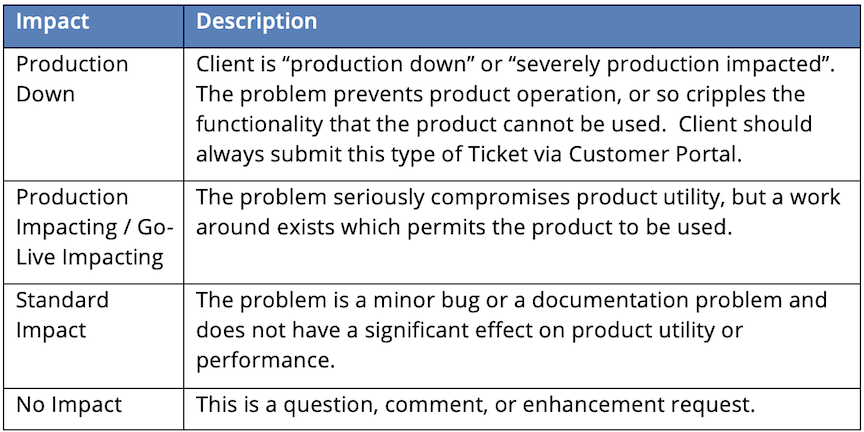
- Resolution of Tickets of “No Impact” will be addressed at the convenience of DSI in its sole discretion.
- Client responsibilities when initiating an Ticket:
- Provide description of the issue and provide impact to business. If the issue severely impacts the ability to operate your business, please initiate Tickets for “Production Down” or “Production Impacting / Go-Live Impacting” issues via Customer Portal using the published support number from the main website, https://support.cloudinventory.com.
- Check the CSC website to confirm that the Ticket is not a duplicate issue.
- Provide CSC engineer with the standard Ticket content information as defined in Section 5.1.
- Make Client personnel available to dialogue with and otherwise assist CSC personnel with troubleshooting and diagnostic activities.
- Allow access to Client systems sufficient for CSC engineers to observe, diagnose, and investigate Tickets.
- DSI responsibilities when receiving an Ticket:
- For “Production Down” Tickets communicated via Customer Portal, CSC engineers shall acknowledge and engage immediately (15 minutes or less) with Client personnel, create a Ticket issue number and shall initiate DSI notification and engagement processes for “Production Down” issues. If CSC engineers reasonably ascertain that Client personnel have inaccurately assessed a “Production Down” Ticket, CSC may reassign severity in accordance with Section 5.2 and will notify Client of such reclassification.
- For all other impact levels, CSC shall immediately acknowledge Tickets and create a Ticket issue number. CSC engineers shall engage with Client on Tickets as follows:
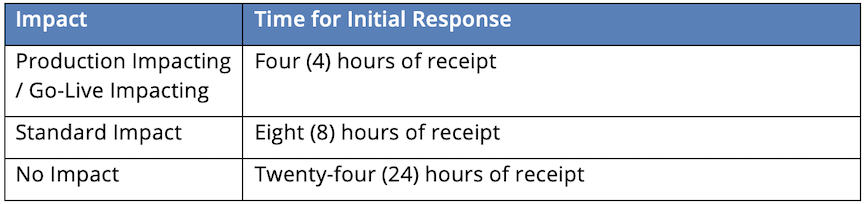
- If CSC engineers reasonably ascertain that Client personnel have inaccurately assessed an issue’s severity or the severity changes during the investigation, CSC may reassign severity in accordance with Section 5.2 and will notify Client of such reclassification.
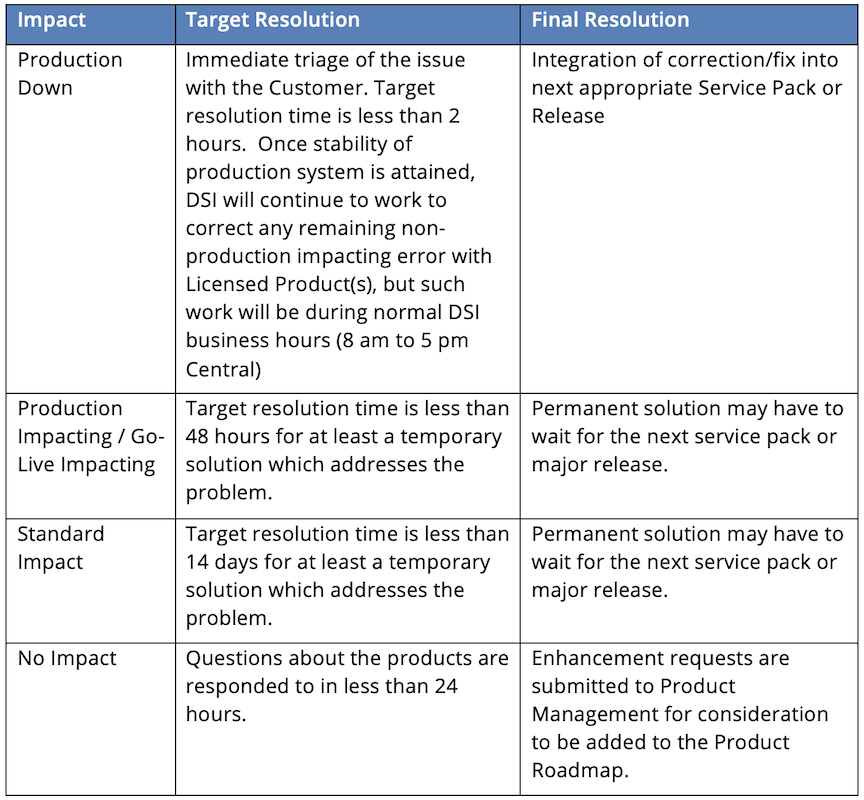
- After Ticket acknowledgment, DSI will endeavor to provide two levels of response (initial and final) to Client’s Ticket. The initial response for severity codes 1-3 will include either an error correction or a work around; for severity codes 4 , an error correction or work around may be provided at the sole discretion of DSI. The final response will include the integration of the fix into the next appropriate Release or Service Pack at DSI’s discretion.
- DSI endeavors to provide initial and final resolution to Tickets according to time windows as a function of severity code. The time windows define the range of the maximum number of working days before DSI provides the designated response to Client. The response intervals are business days. A response time window begins when a Ticket with reproducible results has been acknowledged by DSI. If insufficient information to reproduce the results is received, DSI will notify Client and the status of the Ticket will be shown as waiting until additional information is received.
- Effective October 2025, Version 5.1

 Customer Support